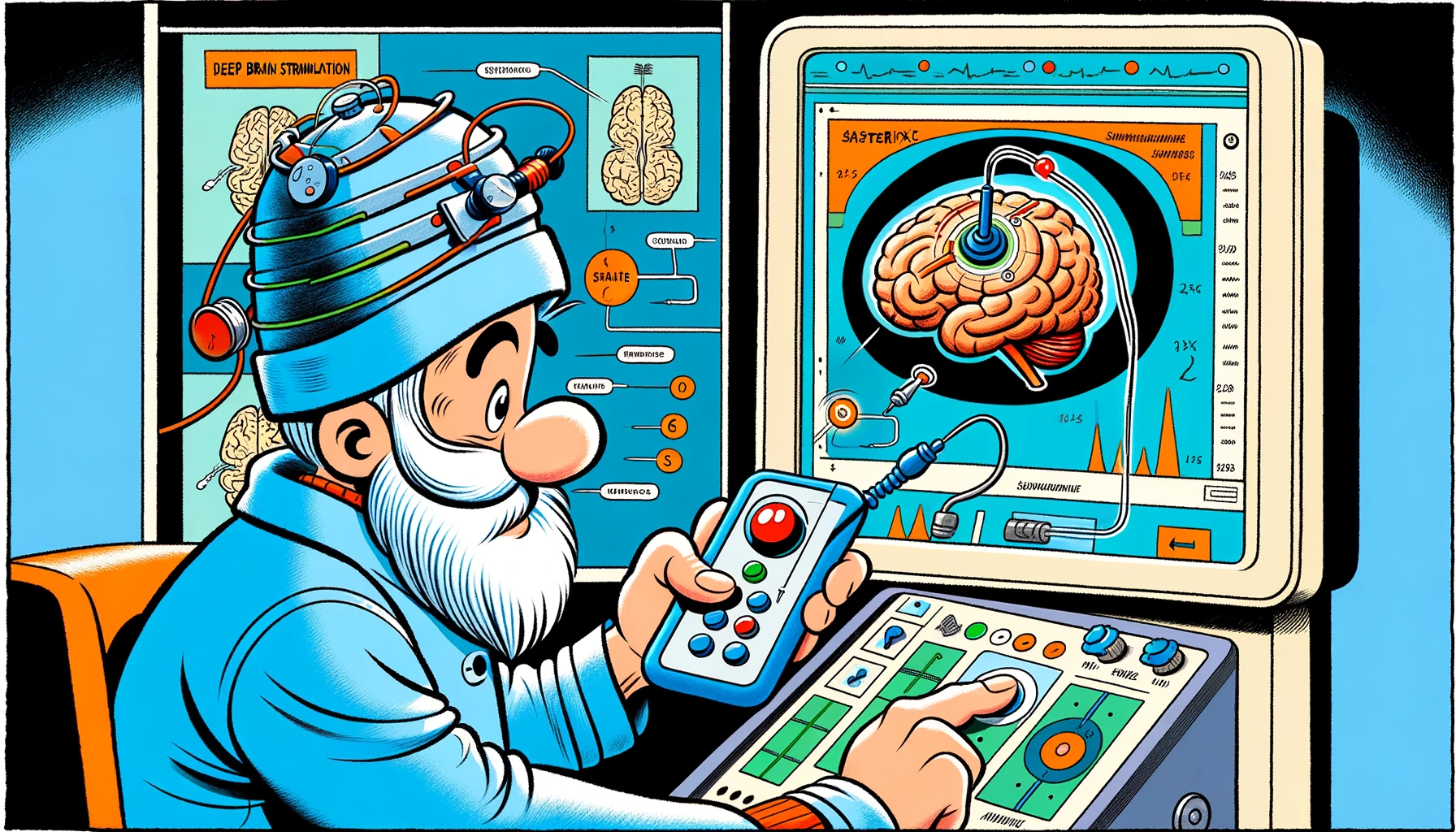
Discover the groundbreaking insights into how optogenetic fMRI unveils the therapeutic circuits activated by subthalamic nucleus deep brain stimulation, revolutionizing our understanding and treatment of neurological disorders.
– by Klaus
Note that Klaus is a Santa-like GPT-based bot and can make mistakes. Consider checking important information (e.g. using the DOI) before completely relying on it.
Optogenetic fMRI reveals therapeutic circuits of subthalamic nucleus deep brain stimulation.
Li et al., bioRxiv 2024
<!– DOI: 10.1101/2024.02.22.581627 //–>
https://doi.org/10.1101/2024.02.22.581627
Ho-ho-ho! Gather around, my curious elves, for a tale of scientific wonder, a story that twinkles with the magic of deep brain stimulation (DBS) in the frosty realm of Parkinson’s disease (PD). In a workshop not made of gingerbread, but of cutting-edge technology, researchers embarked on a sleigh ride through the brain’s snowy peaks and valleys, guided by the bright star of function magnetic resonance imaging (fMRI).
In this yuletide narrative, our heroes are not reindeer, but female hemi-parkinsonian rats, bravely volunteering to explore the mysteries of DBS. With the help of optogenetics, a technique as magical as Santa’s sleigh, they delivered pulses of light to the subthalamic nucleus (STN), a region as bustling as Santa’s workshop, to mimic the effects of DBS at various pulse repetition rates.
As the lights danced like Christmas lights, changes in the brain’s activity were observed, lighting up regions known as SNr (substantia nigra pars reticulata), GP (globus pallidus), and CPu (caudate putamen) like houses on Christmas Eve. These changes were not just for show; they had the power to reduce the rats’ pathological circling behavior, a gift more precious than any under the tree, but only in those expressing the kinetically faster Chronos opsin, a type of protein that responds to light, and not in those with ChR2.
But what was the secret ingredient in this holiday miracle? Through the magic of mediation analysis, it was revealed that the joyous behavioral rescue was significantly mediated by the activity changes in GP and CPu, but SNr, though twinkling brightly, was not the star atop our Christmas tree. This enchanting discovery suggests that activating GP and CPu is akin to finding the perfect toy for a child, the key to the therapeutic magic of STN DBS.
So, as we close the book on this festive tale, let us remember the spirit of discovery and hope that guides us, like Rudolph’s red nose, through the darkest of nights, bringing light to those in need. Merry Christmas to all, and to all a good night of scientific inquiry!