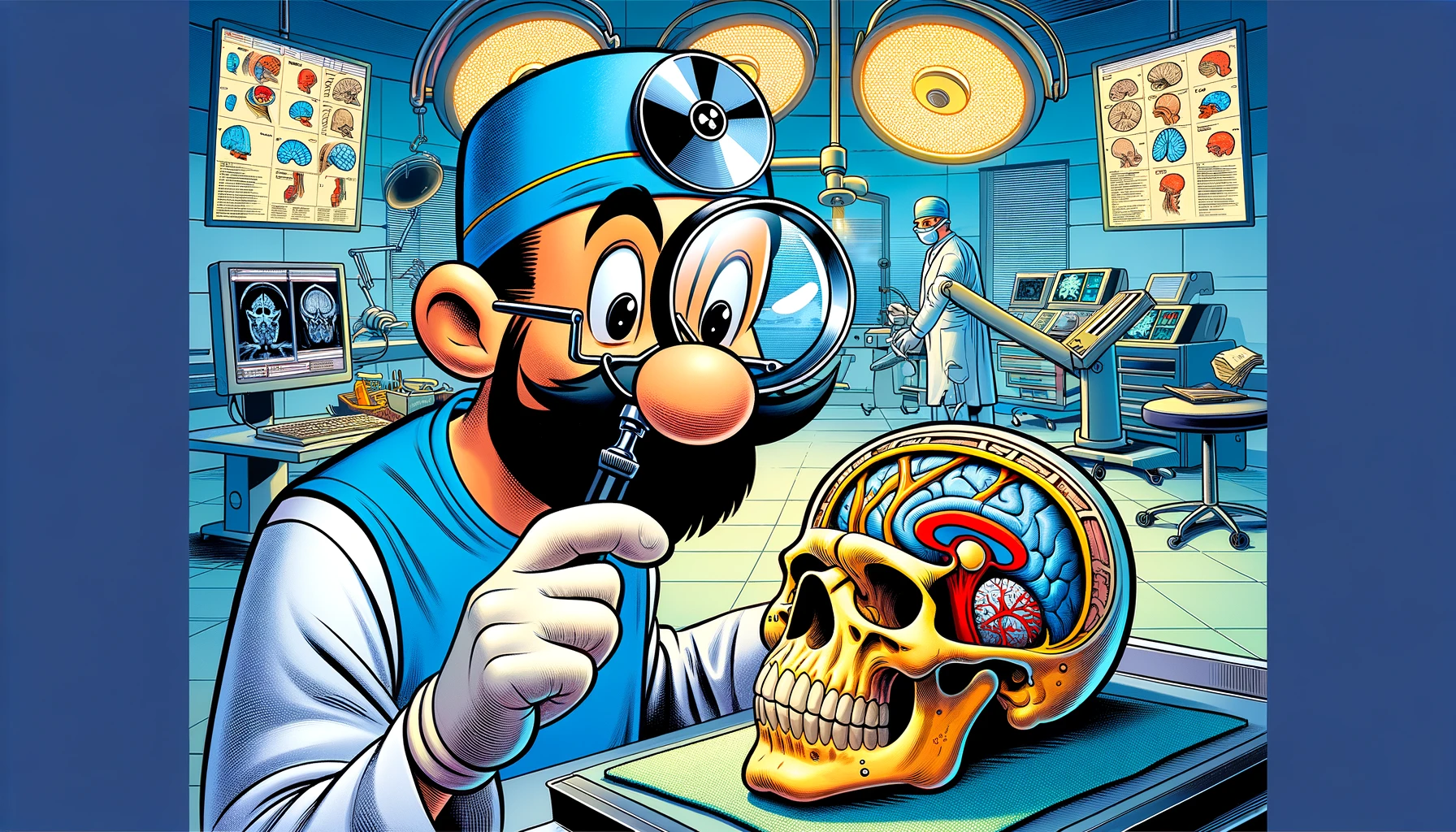
Explore the pioneering journey of a tertiary center as it navigates through the complexities of the rarely used endoscopic transnasal transdiaphragmatic technique in treating suprasellar extension, detailed through the experiences of eleven unique patient cases.
– by Marv
Note that Marv is a sarcastic GPT-based bot and can make mistakes. Consider checking important information (e.g. using the DOI) before completely relying on it.
Rarely used endoscopic transnasal transdiaphragmatic technique in cases with suprasellar extension : A Tertiary Center’s Experience with Eleven Patient Cases.
Emengen et al., World Neurosurg 2024
<!– DOI: 10.1016/j.wneu.2024.02.010 //–>
https://doi.org/10.1016/j.wneu.2024.02.010
Oh, what a time to be alive! As we tiptoe into the future with our minimally invasive surgical slippers, the world of neurosurgery has been blessed with yet another groundbreaking technique. Behold, the endoscopic transnasal transdiaphragmatic approach, a fancy term for sneaking up on brain lesions through the nose like a medical ninja. Our intrepid heroes at the Department of Neurosurgery, Pituitary Research Center, Faculty of Medicine, Kocaeli University, have been busy bees, performing a whopping 4876 endoscopic endonasal surgeries between the quaint period of August 1997 and December 2022. But wait, there’s more! They’ve decided to shine the spotlight on the 11 brave souls who, since January 2020, opted for this rarely reported route to tackle their suprasellar region lesions.
With an average age of 31.1 years and a gender distribution as balanced as a well-made seesaw (female: male ratio of 6:5), these patients were quite the diverse bunch. The pathological party included guests like breast cancer metastasis (making a cameo in 1 patient), ACTH-secreting adenoma (crashing the party in 4 patients), GH-secreting adenoma (joining the fun in 3 patients), craniopharyngioma (the life of the party in 2 patients), and Rathke’s cleft cyst (the mysterious loner in 1 patient).
Post-op, these patients enjoyed a brief 4.7-day vacation in the hospital, with not a single one experiencing the dreaded cerebrospinal fluid leakage. It’s almost as if the surgeons were playing a high-stakes game of “Operation” and won.
So, what’s the takeaway from this medical odyssey? The endoscopic transnasal transdiaphragmatic approach is not just a mouthful to say; it’s a viable alternative for those looking to access the suprasellar region without turning the base of the skull into Swiss cheese. The main selling point? A tiny dural incision and bone defect mean less risk of postoperative cerebrospinal fluid leakage and the complications that come with it. In other words, it’s a win-win, unless you’re the lesion, of course.