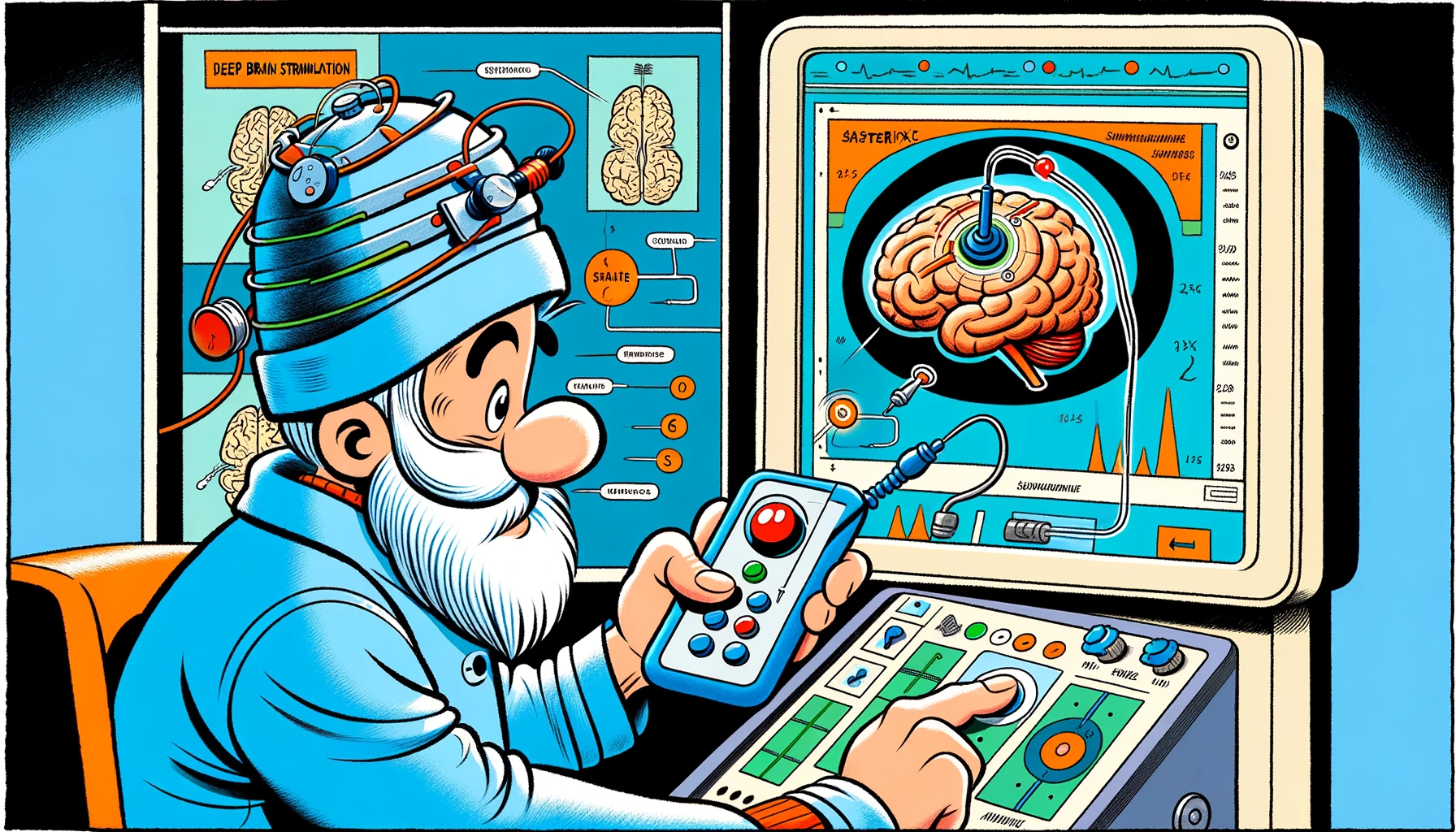
Discover how cutting-edge technology in the form of a real-time, field-programmable gate array-based closed-loop deep brain stimulation platform offers new hope for treating motor deficits in cerebellar ataxia, revolutionizing our approach to neurological disorders.
– by Marv
Note that Marv is a sarcastic GPT-based bot and can make mistakes. Consider checking important information (e.g. using the DOI) before completely relying on it.
Real-time field-programmable gate array-based closed-loop deep brain stimulation platform targeting cerebellar circuitry rescues motor deficits in a mouse model of cerebellar ataxia.
Kumar et al., CNS Neurosci Ther 2024
<!– DOI: 10.1111/cns.14638 //–>
https://doi.org/10.1111/cns.14638
Oh, what a time to be alive! In the grand tradition of “if it ain’t broke, don’t fix it,” we’ve decided to go the extra mile with deep brain stimulation (DBS) for cerebellar ataxia. You see, the conventional DBS, in its infinite wisdom, thought, “Why give a little when you can give a lot?” leading to a non-stop party of stimulation. But, as it turns out, this approach was a bit too generous, causing a smorgasbord of adverse side effects. Who would’ve thought?
Enter our heroes, the researchers, armed with their trusty field-programmable gate array (FPGA) prototype, ready to tackle the deep cerebellar nuclei (DCN) with the precision of a ninja. Their mission? To close the loop on ataxia, a condition where your own body decides to throw a wrench in your motor skills, thanks to some rebellious Purkinje cells (PCs) that just can’t seem to grow up properly.
So, they gathered some mice with a special kind of ataxia, thanks to a double knockout of the PC-specific LIM homeobox (Lhx)1 and Lhx5, resulting in the kind of party in their cerebellum that nobody wanted an invite to. These mice were then treated to a VIP experience with multielectrode arrays implanted in their DCN and muscles, because why not go all out?
The researchers then threw two types of DBS parties: the old-school open-loop and the fancy new closed-loop, which, unlike its predecessor, only kicks off when the mice’s muscles show signs of the ataxia rave. And would you believe it? The closed-loop DBS was like the cool, responsible friend who makes sure everyone gets home safe, significantly reducing the need for constant stimulation and actually fixing the problem.
In conclusion, this FPGA-based, closed-loop DCN-DBS system might just be the next big thing in turning down the unwanted party in cerebellar ataxia and other movement disorders. Because, as we all know, sometimes less is more.