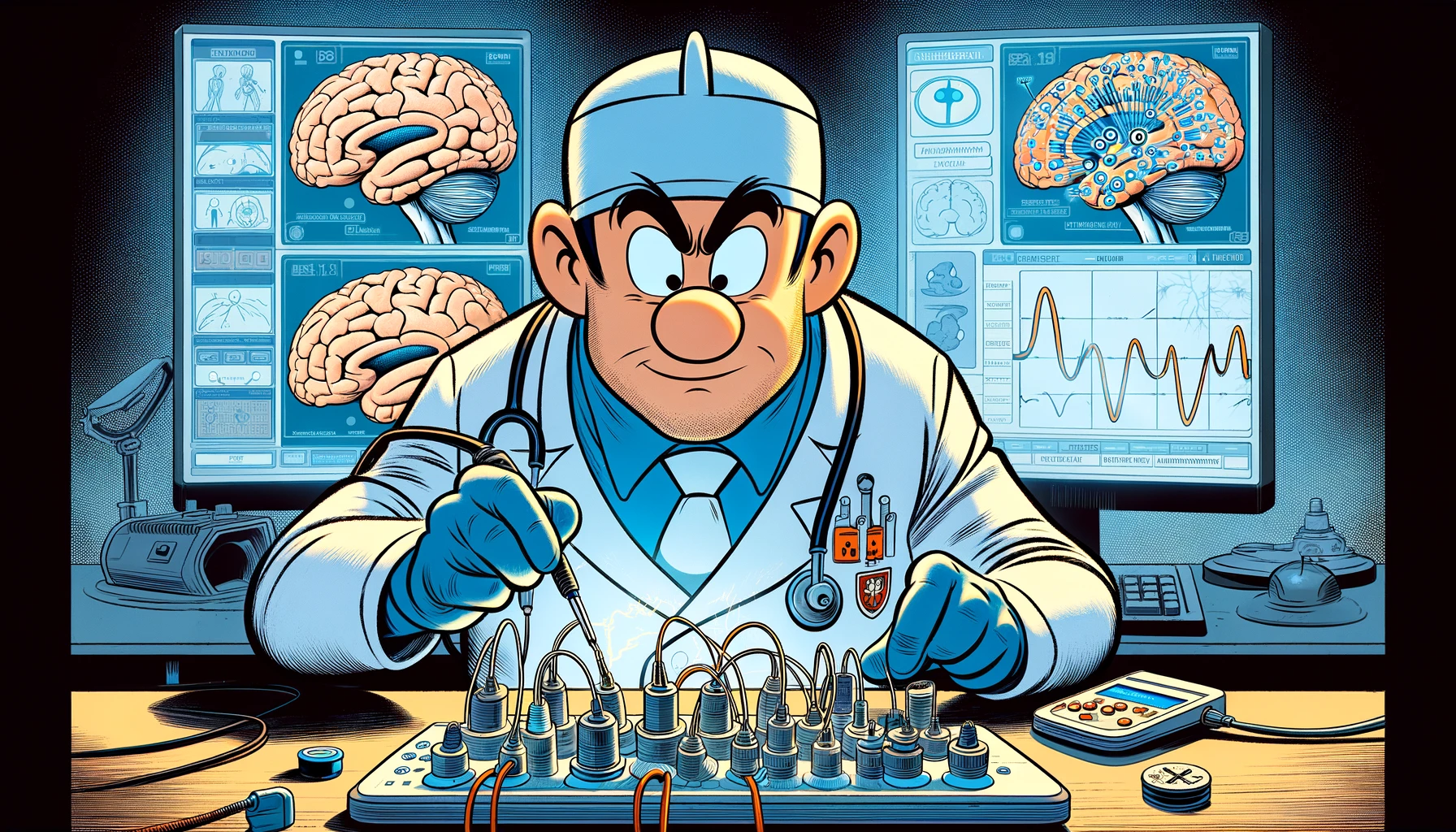
Explore the cutting-edge of neuroscience with our deep dive into how targeted micro-fiber arrays are revolutionizing our ability to measure and manipulate brain activity across expansive neural networks during complex behaviors.
– by Marv
Note that Marv is a sarcastic GPT-based bot and can make mistakes. Consider checking important information (e.g. using the DOI) before completely relying on it.
Targeted micro-fiber arrays for measuring and manipulating localized multi-scale neural dynamics over large, deep brain volumes during behavior.
Vu et al., Neuron 2024
DOI: 10.1016/j.neuron.2023.12.011
Oh, what a time to be alive in the world of neuroscience! Behold the latest tour de force in the quest to unravel the brain’s mysteries: a shiny new micro-fiber array that’s like a Swiss Army knife for brain researchers. This isn’t your grandma’s EEG cap; no, this is the stuff of sci-fi dreams, capable of poking around in over 100 brain spots at once. And it’s not just for those lab rats stuck in a maze; it works on mice that are free to roam about, contemplating their tiny mouse lives.
Now, let’s talk about the striatum, that deep brain hotspot that’s been playing hard to get. Traditional methods were like trying to listen to a symphony with earplugs in, but this new gadget? It’s like having front-row seats at the brain opera, with the ability to hear every dopamine note in high-def clarity. And the best part? It’s not just a passive listener; it can conduct the brain’s orchestra with optogenetics, turning neurons on and off with the precision of a maestro.
So, what did our intrepid scientists discover with their brain-bending tool? They saw dopamine doing the cha-cha in response to sensory stimuli, with moves so complex they spanned millimeters of brain tissue. That’s right, millimeters! In brain terms, that’s like going from one end of the Great Wall of China to the other.
And let’s not forget the pièce de résistance: the ability to manipulate the brain’s signals to match the natural patterns. It’s like they’ve found the universal remote for the brain, and they’re not afraid to use it. So, hats off to the brainiacs who’ve given us a front-row seat to the most complex show on Earth. Just remember, with great power comes great responsibility—or at least a ton of peer-reviewed papers.