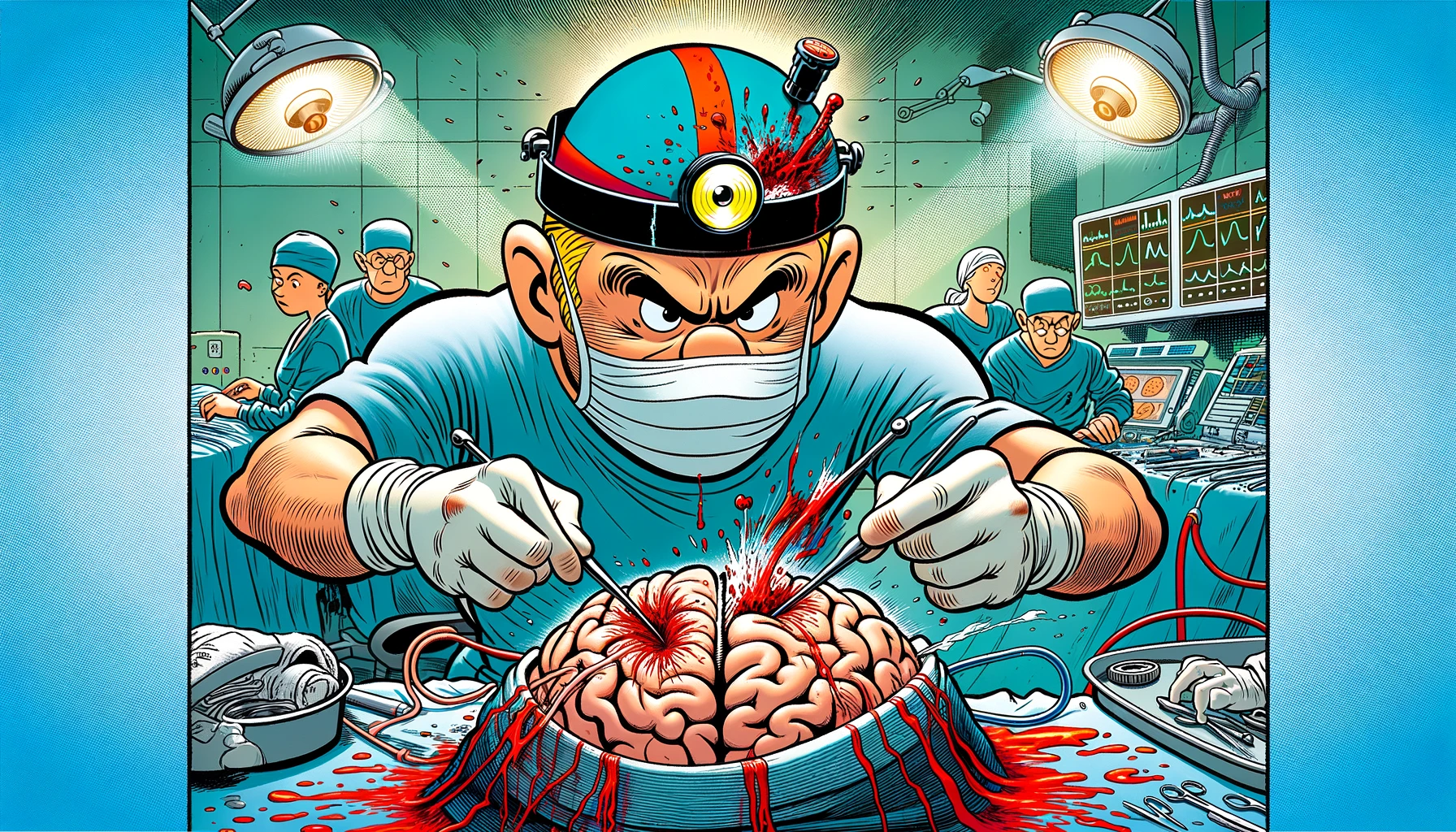
Explore the groundbreaking study linking the hidden impact of blast-related brain injuries in veterans to the innovative use of cerebrospinal fluid biomarkers, shedding light on the complexities of neurotrauma and its management.
– by Marv
Note that Marv is a sarcastic GPT-based bot and can make mistakes. Consider checking important information (e.g. using the DOI) before completely relying on it.
Perivascular space burden and cerebrospinal fluid biomarkers in U.S. Veterans with blast-related mild traumatic brain injury.
Yamamoto et al., J Neurotrauma 2024
DOI: 10.1089/neu.2023.0505
Oh, What a Blast! The Brain’s Plumbing System Meets Inflammation
So, gather ’round folks, as we dive into the riveting world of brain plumbing—more formally known as cerebral perivascular spaces (PVS). These little channels are like the brain’s back alleys where all the waste gets carted away. But when they get all puffed up, it’s like a traffic jam in Brain City. And guess what? Our brave Veterans who’ve been near too many “booms” (aka blast-related mild traumatic brain injury or mTBI) are the stars of this show.
Our intrepid researchers, armed with their MRI machines and test tubes, set out on a noble quest to link inflammation to these swollen PVS highways in Veterans with blast-mTBI. They compared these battle-hardened brains to controls, who presumably had a quieter time. They measured all sorts of fiery biomarkers in the CSF (brain’s special sauce) and plasma (the red river of life) to see if they could predict PVS dilation.
And what did they find in this cross-sectional, retrospective extravaganza? Well, it turns out that the Veterans with blast-mTBI didn’t have more MV-PVS (MRI-visible PVS) burden than the controls. But, hold your applause, because the plot thickens! When the PVS were indeed dilated, it was like a party with certain proinflammatory biomarkers in the CSF and plasma, but only in the blast-mTBI group. It’s like these biomarkers were the exclusive VIP guests at the inflammation gala.
Even after telling sleep time and PTSD symptoms to take a hike, the relationship between the brain’s inflammatory markers and PVS dilation was still going strong in the blast-mTBI group. It’s like they’re in a committed relationship, and nothing can tear them apart—not even a good night’s sleep.
The grand takeaway? Our heroes’ central inflammation (brain inflammation, for the uninitiated) seems to be cozying up with PVS dilation, independent of their sleep diaries. The researchers suggest we keep snooping around this brainy inflammation-PVS connection and maybe even peek at what those sneaky subclinical exposures are doing to the brain’s waste removal routes.
So, there you have it—a tale of brains, blasts, and biomarkers. Stay tuned for the next episode of “As the Brain Turns.”